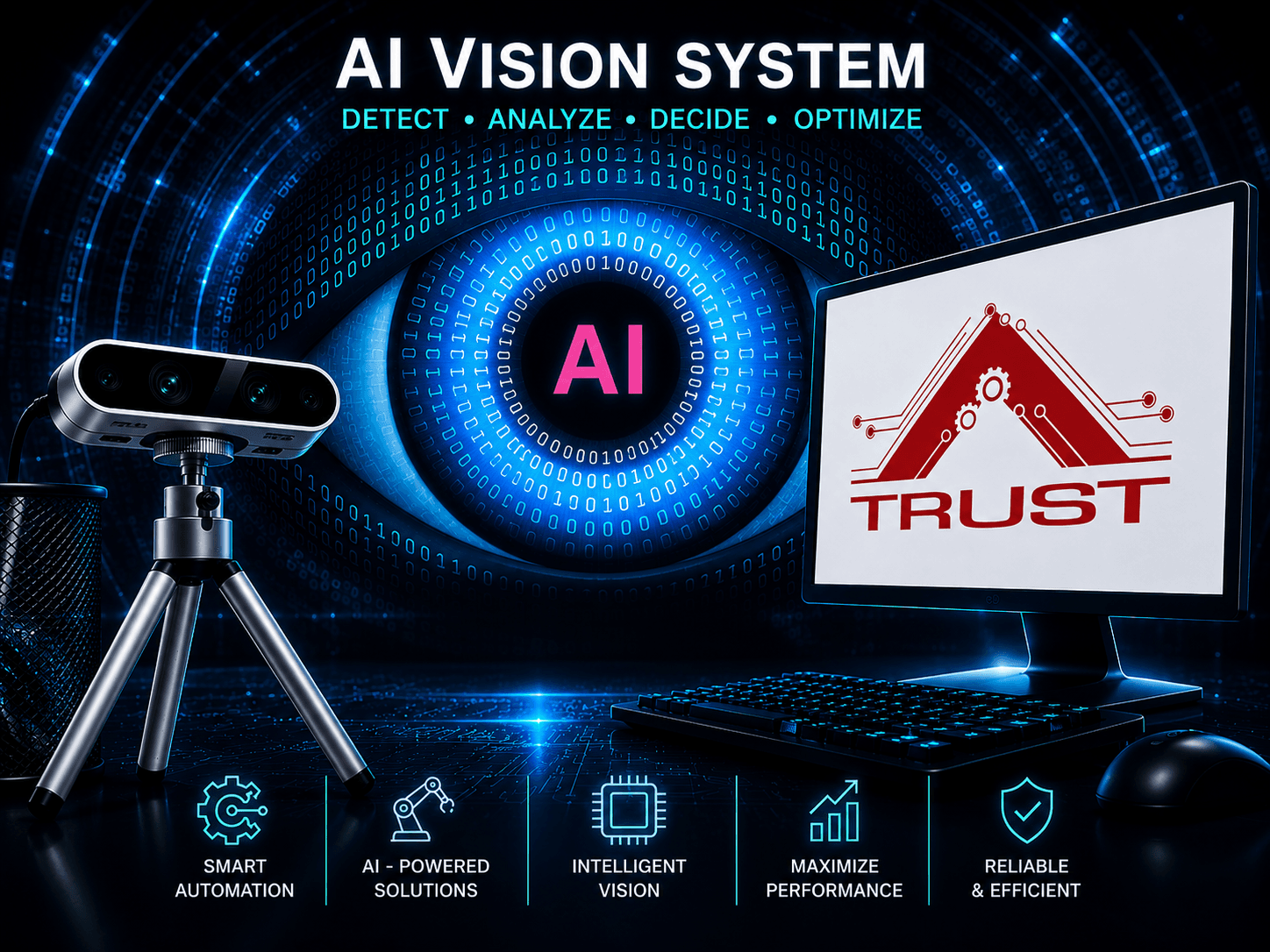
Machine Vision & AI Vision
MACHINE VISION & AI VISION – AUTOMATED VISUAL QUALITY INSPECTION SOLUTIONS
When Machines Can “See” and Make Decisions
In industrial manufacturing, many quality inspection processes still rely heavily on human visual inspection, such as checking product appearance, determining whether a product is correct or incorrect, reading product codes, verifying barcodes, detecting missing components, and classifying products.
However, as production lines become faster and quality requirements become increasingly demanding, manual inspection may face limitations in terms of speed, consistency, and data traceability.
Machine Vision & AI Vision enable machines to “see,” analyze images, and automatically make inspection decisions.
A typical system can be simply illustrated as:
Product → Camera → Image Processing / AI → Inspection → OK / NG → Sorting
Using a camera installed on the production line, the system can determine what the product is, whether it is correct, whether defects are present, and whether the product code is correct, then send the inspection result to a PLC or control system for the next action.
Machine Vision and AI Vision
Traditional Machine Vision uses cameras combined with image-processing algorithms to perform tasks based on relatively well-defined rules, such as:
Pattern Matching – Measurement – Position Detection – Barcode Reading – OCR – Presence/Absence Inspection
For more complex applications, where product shapes or defects have significant variations and are difficult to describe using fixed rules, AI Vision can be applied.
Through Machine Learning and Deep Learning, the system can learn from image data to perform:
Object Detection – Classification – Segmentation – Defect Detection
We do not consider Machine Vision and AI Vision to be two completely separate technologies.
Depending on the actual application, the system can use traditional Machine Vision, AI Vision, or a combination of both to achieve the required level of stability, speed, and efficiency.
Product Appearance Inspection
Cameras can be installed directly on production lines to capture product images during the manufacturing process.
Image-processing software then analyzes the required characteristics and generates an inspection result:
Image → Inspection → OK / NG
Depending on the application, the system can inspect:
Product shape
Color
Position
Dimensions
Missing or extra components
Correct/incorrect assembly
Surface defects
Visual abnormalities
Correct/incorrect products
The inspection result can be sent directly to a PLC to activate a rejection mechanism and automatically remove defective products from the production line.
Barcode, QR Code & Code Reading
Another common Machine Vision application is product code reading and verification.
Industrial cameras and code readers can be used to read:
1D Barcode – 2D Code – QR Code – Data Matrix
The system can not only read the code but also verify it against production information or database records.
For example:
Camera → Read Code → Database Verification → Correct / Incorrect
This makes it possible to detect incorrect product codes, incorrect models, incorrect packaging, or support product traceability throughout the manufacturing process.
OCR – Reading Characters and Product Information
Not all product information is available in the form of a Barcode or QR Code.
In many manufacturing industries, information is printed directly on the product or packaging, such as:
Lot Number – Batch Number – Serial Number – Production Date – Expiry Date – Product Code
Machine Vision combined with OCR can automatically read this information and verify it against the required data.
For example, in the food industry:
Product → Camera → Read Expiry Date → Verify → OK / NG
If the code or production date is incorrect, missing, or unreadable, the system can generate an alarm or automatically reject the product.
Automatic Product Classification
Machine Vision and AI Vision can also function as automated product classification systems.
The camera identifies the product, the software determines its type or condition, and the PLC controls the sorting mechanism.
Product → Camera → Recognition → Classification → PLC → Sorting
Depending on the application, products can be classified according to:
Type – Model – Color – Size – Quality – OK/NG
This allows a production line to handle multiple product types without relying entirely on manual inspection and sorting.
One Technology – Multiple Industries
Machine Vision is not limited to any specific manufacturing industry.
Food & Beverage
In the food and beverage industry, the system can be applied for:
Packaging inspection
Label inspection
Barcode/QR Code reading
Production date and expiry date reading
Missing/extra product inspection
Product classification
Visual inspection
Garment & Textile
In the garment and textile industry, Machine Vision can support product identification and classification, as well as the inspection of color, position, labels, product codes, and other visual characteristics.
Footwear & Leather
For footwear and leather manufacturing, the system can be used for component identification, presence/absence inspection, product classification, and quality inspection throughout the production process.
Woodworking & Furniture
In woodworking and furniture manufacturing, Machine Vision & AI Vision can be applied for:
Surface inspection
Product identification
Defect detection
Component inspection
Product classification
Inspection before and after painting/coating processes
Particularly for surface defects with significant variations in shape and appearance, AI Vision can extend inspection capabilities beyond conventional rule-based image-processing methods.
Metal & General Manufacturing
In metalworking and general manufacturing, the system can perform:
Presence / Absence Inspection
Part Identification
Position & Orientation Inspection
Dimensional Inspection
Assembly Inspection
Surface Condition Inspection
Barcode / QR Code Reading
Product Classification
More Than Just a Camera
A complete industrial Machine Vision system involves much more than simply installing a camera on a production line.
System performance depends on the proper integration of multiple components:
Camera + Lens + Lighting + Trigger Sensor + Image Processing / AI + Industrial PC + PLC + Production System
Lighting and optics help create stable and consistent images.
The camera captures the image.
Machine Vision or AI analyzes the image.
The PLC receives the inspection result and controls the machine.
The database stores inspection data.
And the software allows operators to monitor the results.
This is why we approach Machine Vision as a system integration solution, rather than simply an image-processing task.
From Inspection to Traceability
One of the key advantages of automated inspection is that inspection results can be digitalized.
Each inspection can generate data such as:
Time → Product → Image → Code → Inspection Result → OK/NG
This data can be stored in a database and connected to production management systems.
Machine Vision can then go beyond answering:
“Is this product OK or NG?”
It can also help answer:
“Which product was defective?”
“When did the defect occur?”
“Which type of defect occurs most frequently?”
“What did the product look like at the time of inspection?”
This represents the transition from Automated Inspection to Quality Data & Traceability.
Solutions Designed for Each Application
There is no single camera system that is suitable for every application.
A Barcode reading application is completely different from a surface defect inspection application.
Dimensional inspection is different from product recognition.
Likewise, a system processing 10 products per minute has very different requirements from a production line processing hundreds of products per minute.
For this reason, we develop solutions based on the actual requirements of each application:
Understand the Product
↓
Define the Inspection Requirement
↓
Select Camera, Lens & Lighting
↓
Develop Vision / AI Algorithm
↓
Integrate with PLC & Machine
↓
Test & Optimize
↓
Deploy to Production
The ultimate objective is not to apply AI to every inspection task.
The objective is to select the most appropriate technology to solve each customer's inspection requirements in a stable and efficient way.
MACHINE VISION & AI VISION
See the Product – Understand the Image – Make the Decision – Control the Process
From visual inspection, Barcode/QR Code reading, and OCR to product recognition, classification, and AI-based defect detection, we develop customized Machine Vision & AI Vision solutions that can be directly integrated with machinery, PLCs, and production lines.
From Image to Decision – From Inspection to Intelligent Quality Control.