THE " EYES" OF THE SMART FACTORY
In the journey toward digital transformation and the development of smart factories, Machine Vision has become one of the most important technologies, enabling manufacturers to improve product quality, optimize production processes, and reduce operating costs.
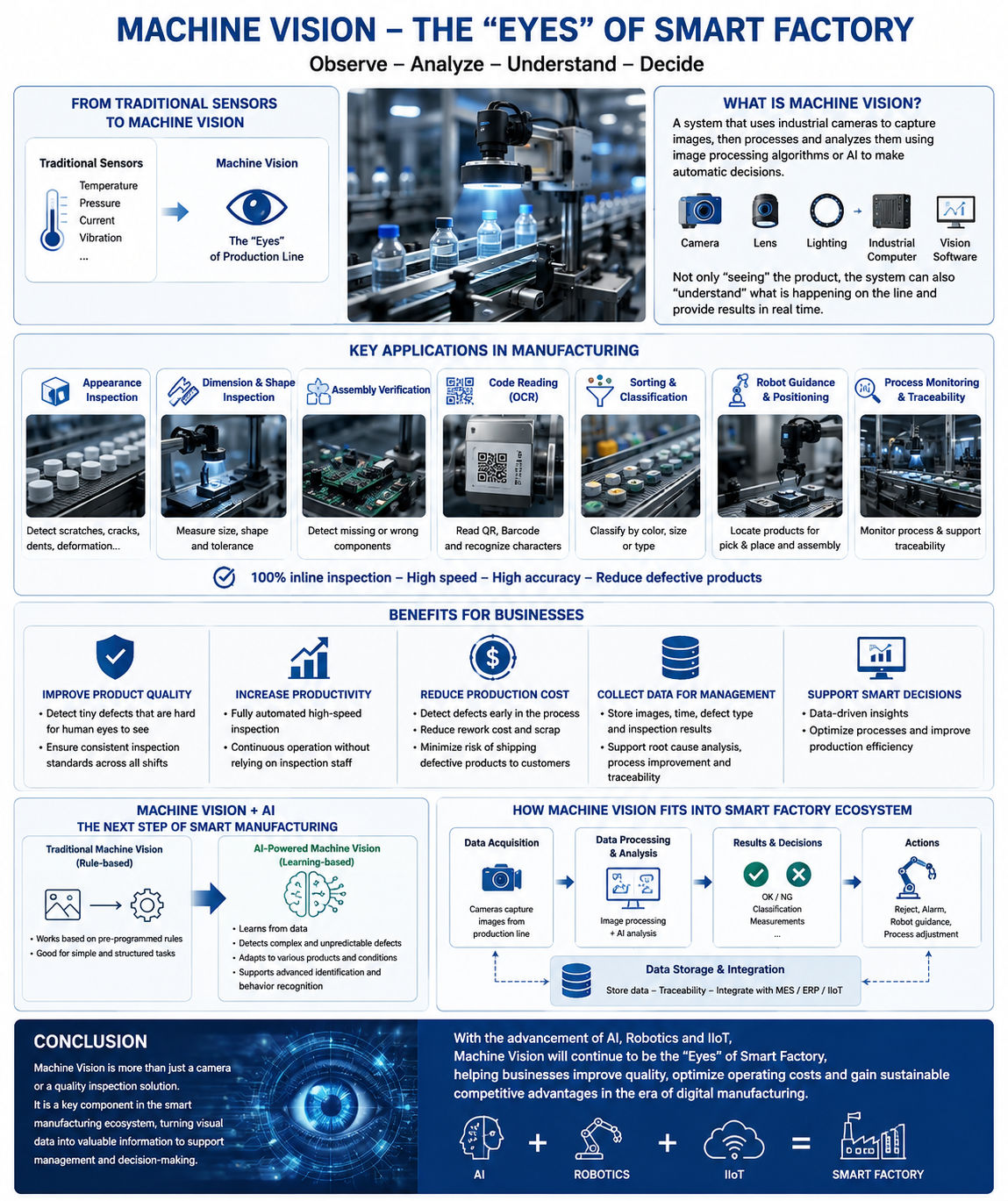
While traditional sensors are responsible for measuring physical parameters such as temperature, pressure, electrical current, and vibration, Machine Vision serves as the "eyes" of the production line. By combining industrial cameras with image processing software and Artificial Intelligence (AI), the system can observe, analyze, and evaluate products with speed and accuracy far beyond human capability.
What is Machine Vision?
Machine Vision is a system that uses industrial cameras to capture images, which are then processed and analyzed using image processing algorithms or AI to make automated decisions. A complete Machine Vision system typically consists of industrial cameras, lenses, lighting systems, industrial computers, and image processing software.
Rather than simply "seeing" products, the system is capable of "understanding" what is happening on the production line and delivering inspection results almost in real time.
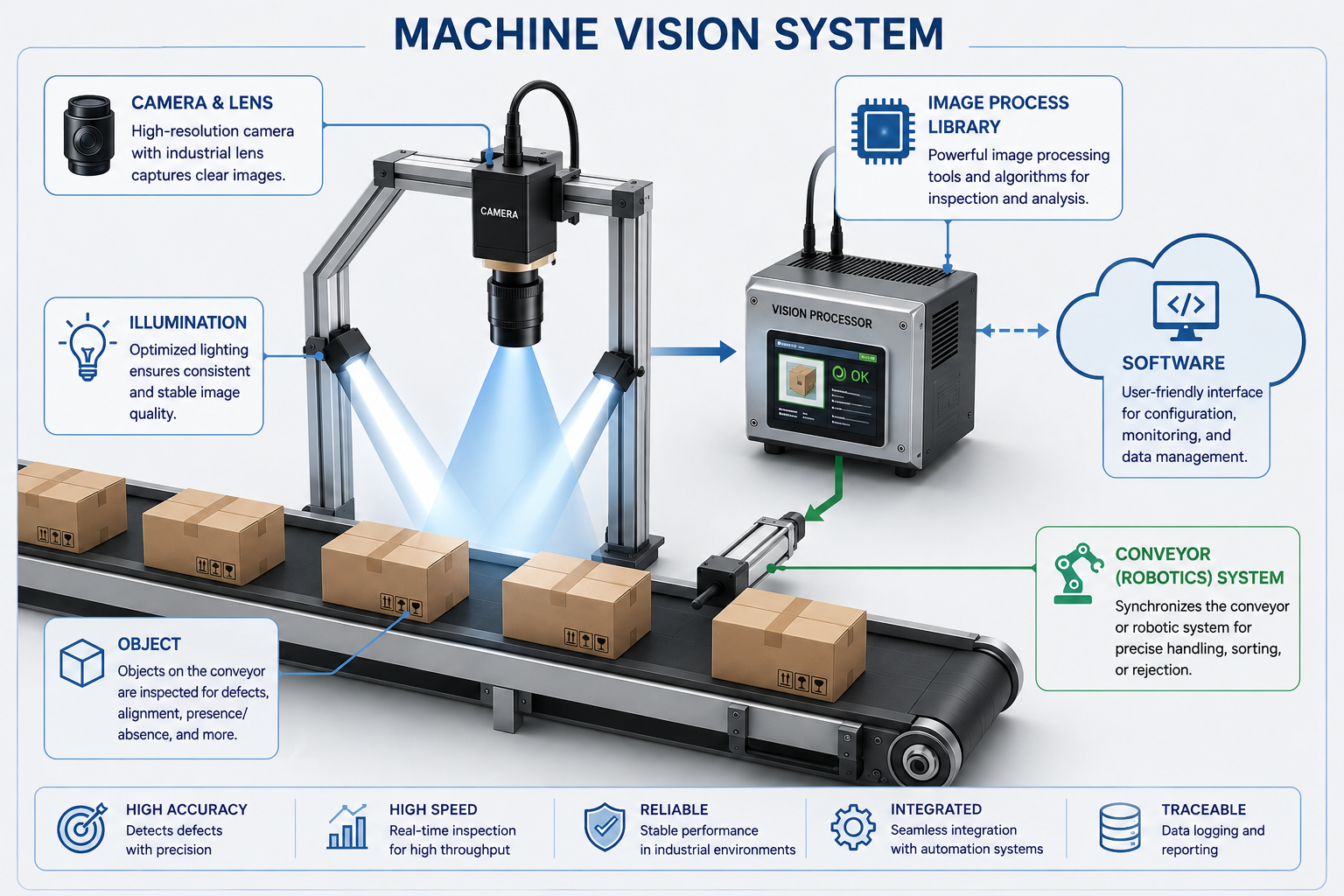
Applications in Manufacturing
Today, Machine Vision is widely applied across various industries, including electronics, automotive, food and beverage, pharmaceuticals, packaging, woodworking, metal processing, and logistics.
Typical applications include:
Visual inspection of product appearance (scratches, cracks, dents, deformation, etc.).
Dimensional and shape inspection.
Detection of missing or incorrectly assembled components.
QR code and barcode reading, as well as Optical Character Recognition (OCR).
Product classification based on color, size, or type.
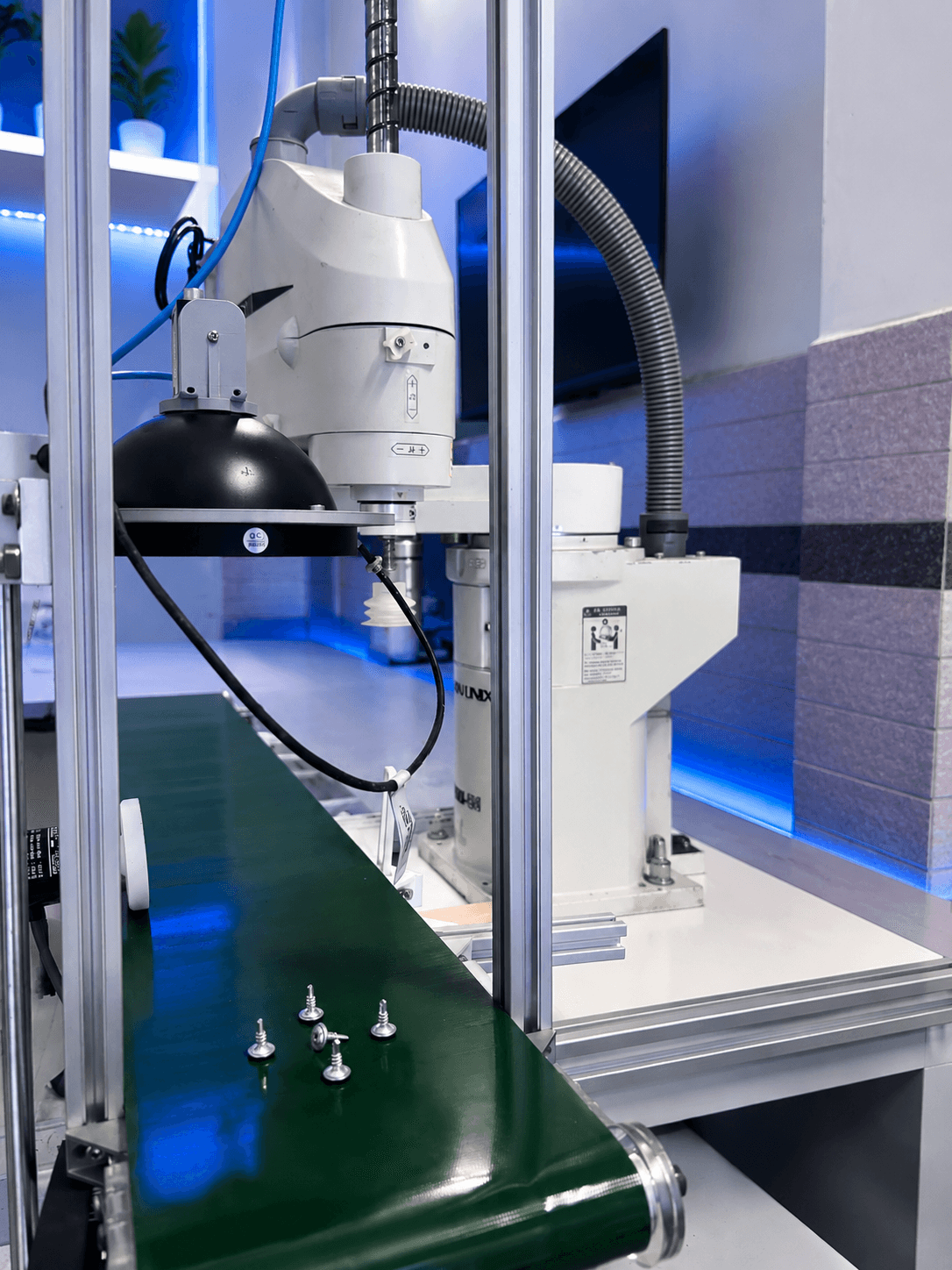
Product positioning for robotic pick-and-place and assembly.
Production process monitoring and product traceability.
Unlike manual inspection methods, Machine Vision can inspect 100% of products on the production line while maintaining high speed and accuracy, significantly reducing the risk of defective products reaching customers.
Benefits for Businesses
The implementation of Machine Vision not only automates quality inspection but also provides significant value in manufacturing management.
Improve Product Quality
The system can detect extremely small defects that are difficult for the human eye to recognize while ensuring consistent inspection standards across all production shifts.
Increase Productivity
Inspection is performed entirely automatically at high speed, allowing production lines to operate continuously without depending on the number of inspection personnel.
Reduce Production Costs
Detecting defects immediately during production helps reduce repair costs, minimize scrap, and lower the risk of defective products being packaged or delivered to customers.
Collect Data for Manufacturing Management
Every inspection generates valuable data, including images, timestamps, defect types, and inspection results. This information serves as an important resource for root cause analysis, process improvement, and product traceability.
Machine Vision and AI – The Next Step in Smart Manufacturing
Traditional Machine Vision systems operate based on predefined rules and programmed algorithms. Today, with the support of Artificial Intelligence (AI), Machine Vision systems can learn from data to recognize complex defects that were previously difficult to detect.
AI enables Machine Vision systems to adapt to different product types, improve inspection accuracy, perform product classification, recognize human behavior, and support a wide range of advanced manufacturing management applications.
As a result, the system no longer performs only inspection tasks but also becomes a valuable source of manufacturing data, helping businesses analyze production performance, optimize processes, and make data-driven decisions.
Conclusion
Machine Vision is far more than an industrial camera system or a quality inspection solution. It is a key component of the smart manufacturing ecosystem, where visual data is transformed into valuable information that supports manufacturing management and decision-making.
In the future, together with the continued advancement of Artificial Intelligence (AI), Robotics, and the Industrial Internet of Things (IIoT), Machine Vision will continue to serve as the "eyes" of the smart factory, enabling businesses to improve product quality, optimize operating costs, and build sustainable competitive advantages in the era of digital manufacturing.