WHY SHOULD TECHNOLOGY BE APPLIED IN MANUFACTURING?
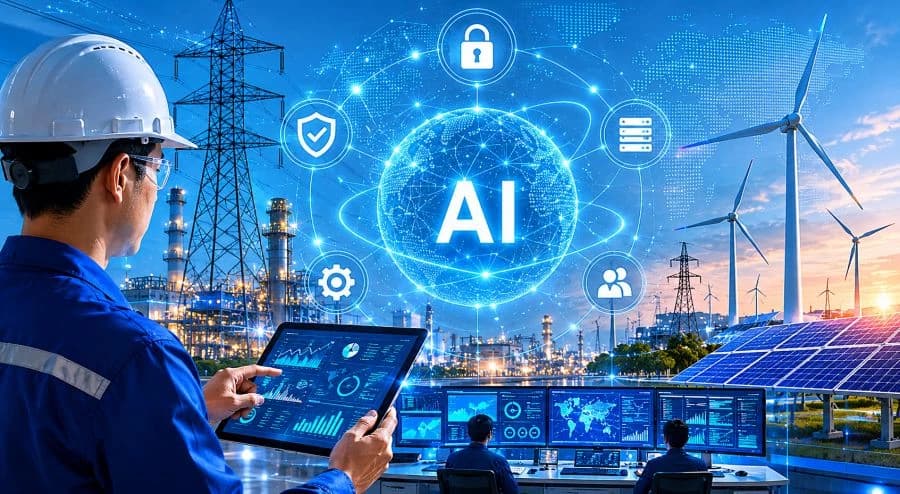
The essence of digital transformation in manufacturing is not about installing more equipment or software. It is about transforming data generated by machines into valuable information, and then converting that information into decisions that help businesses reduce costs, increase productivity, and continuously improve product quality.
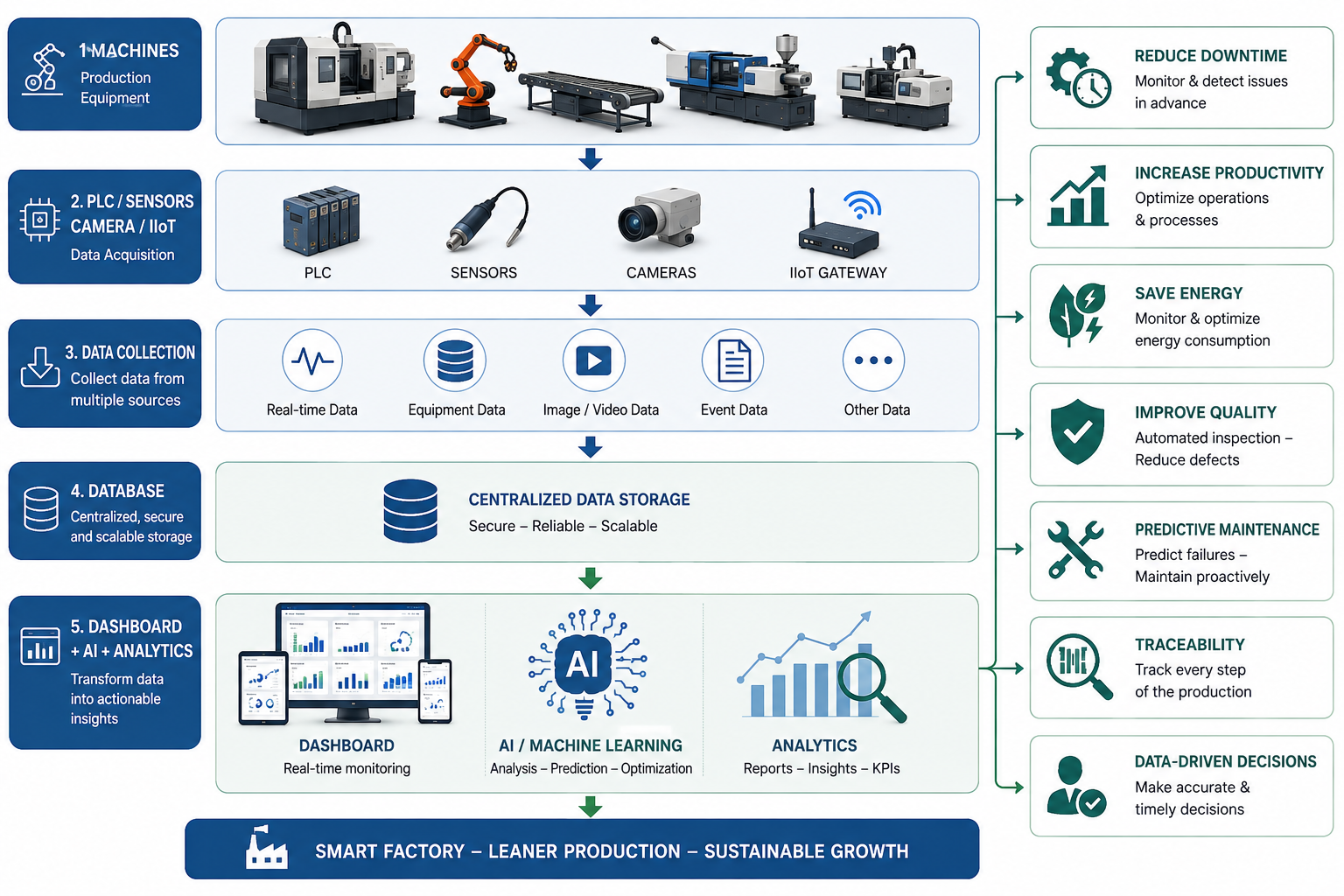
Every day, a manufacturing plant generates millions of data points from machines, equipment, and human operations. Motor speed, power consumption, pipeline pressure, temperature, vibration, production output, machine downtime, product quality, and operating status are all valuable sources of information. However, if this data remains stored only in instruments or PLCs without being utilized, it creates little to no value for the business.
This is precisely why technology has become essential. Technology enables businesses to collect, store, analyze, and visualize data, transforming isolated numbers into meaningful information. As a result, managers no longer need to rely primarily on experience or intuition but can make decisions based on real-time data from the production floor.
In the past, many manufacturers only became aware of equipment failures after an entire production line had already stopped. Maintenance was typically performed on a fixed schedule or only after equipment had failed, leading to extended downtime and high repair costs. With modern monitoring systems, businesses can continuously track parameters such as electrical current, vibration, temperature, pressure, and power consumption to detect abnormal conditions at an early stage. This allows maintenance to be performed at the right time, significantly reducing the risk of unexpected failures while improving the overall reliability of the production system.
Beyond reducing downtime, technology also enables businesses to gain a clear understanding of equipment performance. A machine may remain powered on throughout the day, yet the actual time spent producing value-added products may account for only a small portion of its operating time. Likewise, a production line may appear busy, while operational data reveals that a significant amount of time is actually lost due to waiting for materials, waiting for operators, or delays from upstream processes. Only through objective data can businesses accurately identify production bottlenecks and implement effective improvement measures.
As energy costs continue to rise, monitoring energy consumption has become another significant benefit of technology-driven manufacturing management. Instead of knowing only the total electricity consumption of an entire factory at the end of each month, businesses can monitor the energy usage of individual machines, production areas, or entire systems. This enables them to identify inefficient equipment, optimize fan speed using variable frequency drives (VFDs), reduce power consumption during low-demand periods, and coordinate with battery energy storage systems or solar power generation to minimize operating costs.
Technology also plays a vital role in improving product quality. Industrial camera systems combined with Artificial Intelligence (AI) can perform automated visual inspection, defect detection, QR code reading, optical character recognition (OCR), and dimensional measurement with significantly higher speed and consistency than manual inspection. At the same time, production data can be stored to provide complete product traceability, allowing manufacturers to identify exactly which machine produced a product, when it was manufactured, under what operating conditions, and by whom.
However, one important point must be emphasized: digital transformation does not mean collecting as much data as possible. This is a common misconception. The true value lies not in the quantity of data collected, but in the ability to acquire the right data to support effective management and decision-making.
A company does not need to install hundreds of sensors if the collected data is never used. Instead, businesses should begin by identifying the problems they need to solve, then determine which signals should be collected, and finally select the most appropriate technologies for implementation. This approach is fundamentally different from investing in technology simply because it is popular, where large numbers of devices are purchased without creating real business value.
This process can be summarized as the following value chain:
Management Needs → Data to be Collected → Data Acquisition → Data Analysis → Information → Decision Making → Production Improvement
Without the final step of taking action and implementing improvements, even the most advanced monitoring system remains nothing more than a tool for displaying data rather than creating business value.
Therefore, the essence of applying technology in manufacturing management is not about building a factory filled with sensors, robots, or sophisticated software. The real purpose is to use technology as a tool for transforming data into knowledge, knowledge into decisions, and decisions into continuous improvements throughout the manufacturing process.
A successful technology system is not the one that collects the largest amount of data. Instead, it is the one that enables managers to answer the most important questions quickly and accurately:
What is happening?
Why is it happening?
What is likely to happen next?
What should the business do right now to improve production performance?
That is the true value—and the fundamental essence—of applying technology in manufacturing management in the era of modern industry.